
The BRIDGE Center
The Bridge is a hub for students to connect and access resources, programming and training that advances a culture of inclusion, safety and belonging at JWU.
The Bridge serves the entire JWU community, including Providence, Charlotte and JWU Online.
In person or online, visit the Bridge to explore important social topics such as ethnicity and culture, sexual and gender identity, racial justice, safe sex practices, relationship violence and more.
The Bridge:
- Promotes policies and practices that advance the JWU culture of being a welcoming place for all students
- Offers content consultation, training and collaboration to students, student groups, JWU departments and community partners
- In collaboration with Student Support & Advocacy Services, offers confidential one-on-one support to students navigating personal identity exploration; experiences of sexual assault, relationship violence or bias; or consultation on programmatic or academic projects
- Supports and works with the academic colleges
- Fosters a physical and digital space for learning and connection
The Bridge supports all members of the JWU community. Each of us has multiple, intersectional identities that may encompass, but are not limited to:
Every individual has unique physical, intellectual, and emotional attributes. People can experience disability physically or mentally (e.g., cognitively or psychologically). Some disability is visible; and some is invisible to observers. Some people are born with disability, and some acquire a disability at a later point in their life.
Disabled people may use disability-first language (e.g., disabled) or person-first language (such as “person with a disability”). Mirror the language a person uses for themselves and simply apologize, correct yourself and move on when you get it wrong. Check in before helping or doing something for a disabled person. When writing or speaking, avoid language that implies ableism, a form of discrimination or prejudice against people with disabilities; ableist language includes stereotypes, generalizations, and/or demeaning terminology.
Universal design is creating an environment that can be accessed, understood and used by all to the greatest extent possible. Accommodations are individual steps, resources or services provided to an individual that allows them to have the same access based on their unique circumstances.
Link to Accessibility Services →
Ethnicity describes groups of people with shared cultural characteristics, which connect individuals and provide a common foundation of history and traditions.
Culture is a shared way of life of a group of people that is passed down from generation to generation and can include customs such as dress, language, religion, rituals, art, behavioral norms and belief systems.
Explore JWU’s student student life and clubs, many of which provide opportunities to engage with cultural and ethnic diversity:
Links TBD Providence Clubs & Activities →
Charlotte Clubs & Activities →
Are you interested in engaging more with your own history and heritage or learning about different cultures? Explore Study Abroad programs: Internal Link TBD
Study Abroad at JWU →
Johnson & Wales University was founded by two women, Gertrude I. Johnson and Mary T. Wales, in 1914 — before they even had the right to vote. This history runs deep in our JWU culture and is a touchstone of who we are — as well as what we can be.
Learn more about our history by watching the 2004 documentary created by retired JWU faculty member, Marian Gagnon, “HERStory: The Founding Mothers of Johnson & Wales.”
Gender is a range of socially constructed characteristics, often thought to pertain to a binary of femininity and masculinity. Gender is often confused or conflated with a person’s sex assigned at birth, which can be male, female or intersex. Language describing gender continues to expand and refine; some labels include: transgender, transwoman/feminine, transman/masculine, non-binary, agender, gender queer, gender fluid.
Genderism describes the belief that people need to conform to the gender roles aligned to their sex-assigned-at-birth in a gender-binary system that includes only female and male (aka: cisgender, cis-man or cis-woman). Other non-cisgender identities have, and in some places continue to, experience bias, discrimination, violence or persecution.
Check in before you assume a person’s gender or pronouns. Consider offering your own pronouns when you introduce yourself or in your digital profile or email signature line. Use inclusive language to address individuals and groups (e.g., folks, friends, students, y’all, everyone). Be sensitive to who and where a person may be out or open about their gender identity; follow their lead.
JWU credentials are required to access the below resource link:
Gender Affirming Resources at JWU →
Intersectional feminism was coined by professor, scholar and attorney Kimberlé Crenshaw as “a prism for seeing the way in which various forms of inequality often operate together and exacerbate each other.” Intersectional feminism examines the ways in which systems of inequality based on gender, race, ethnicity, sexual orientation, gender identity, disability, class and other forms of discrimination “intersect” to create unique dynamics and effects.
Sexism is described as prejudice or discrimination based on one’s sex or gender, often ascribing one sex greater value, worth or power than an/the other.
Relevant courses can be found within JWU’s Gender Studies minor:
JWU Providence: Gender Studies Minor →
JWU Charlotte: Gender Studies Minor →
Nationality refers to the nation(s) that one belongs to by both birth and naturalization. Immigrants are individuals that move to a new country with the intention of remaining in the new country. Refugees are individuals who seek safety by crossing international borders to escape persecution, war, violence or natural disaster.
JWU Global is JWU’s primary resource and advocate on international and intercultural education:
JWU Global link TBD →
See below for educational resources for immigrants, refugees, asylees and other new Americans:
Racial Justice refers to “the systematic fair treatment of people of all races, resulting in equitable opportunities and outcomes for all. Racial justice — or racial equity … is not just the absence of discrimination and inequities, but also the presence of deliberate systems and supports to achieve and sustain racial equity through proactive and preventative measures.” (National Education Association)
Read more about racial justice work at JWU here:
Additional JWU resources relating to racial justice include:
JWU DEI Library Educator Guide
Relevant courses can be found in JWU’s Community Justice minor:
Sexual orientation refers to a person’s romantic and sexual attractions. The dominant sexual orientation in our culture is heterosexual. Heterosexism is defined by Merriam-Webster as “discrimination or prejudice against nonheterosexual people based on the belief that heterosexuality is the only normal and natural expression of sexuality.”
Language describing other sexual orientation continues to expand and refine; some labels for sexual orientations include: gay, lesbian, queer, bisexual, pansexual, asexual, aromantic, demisexual. Other sexual orientations have, and in some places continue to, experience bias, discrimination, violence or persecution.
Do not make assumptions about a person’s romantic or sexual attraction. Use inclusive terms when describing romantic or sexual relationships (e.g., partner, significant other, person you are seeing). Be sensitive to who and where a person may be out or open about their sexual orientation; follow their lead.
Learn more about sexual orientation via JWU Library’s related LibGuide:
Providence and Charlotte campuses host student-lead clubs supporting members of our LGBTQI+ and queer community:
JWU Providence Pride Alliance
JWU Charlotte Pride Student Union
Spirituality typically refers to a belief or sense of connection to something greater than ourselves. This often includes religion.
Many of our campus student-run clubs and organizations offer opportunities to engage with spirituality. See the above links for more information.
The Providence Campus provides prayer and meditation space for all Wildcats on the 7th floor of Snowden Hall (Downcity) and the 2nd floor of the Friedman Center (Harborside). The Charlotte Campus provides prayer and meditation space in the Library.
The university maintains listings of places of worship that are located close to our physical campuses. These can be found as part of the Bridge jwuLink resource list.
Sexual assault and relationship violence are instances or patterns of behavior where one person or group establishes control or power over another person or group by using fear, intimidation, threats or violence. These experiences are often also referred to as: rape, dating violence, domestic abuse, stalking, or interpersonal violence. JWU has specific policies defining these prohibited behaviors and outlining response, support, and adjudication.
Bridge professional staff is available for private consultation, advisement and support for JWU community members impacted by sexual assault or relationship violence, outside of university required reporting. We also provide leadership, subject matter expertise, and consultation for comprehensive education and prevention efforts, including Bystander Training.
If you or someone you know has experienced sexual assault or relationship violence, support is available — regardless of when or where the incident(s) occurred.
Contact the Bridge
There are multiple ways to connect with the Bridge for more information and resources:
- Email us at bridge@jwu.edu
- Follow us on Instagram and Facebook
- Members of the JWU community (JWU credentials required) can access our jwuLink page and join our jwuLink group.
Location:
Xavier Complex
Accessible Address: 29 Claverick St.
Providence, RI 02903
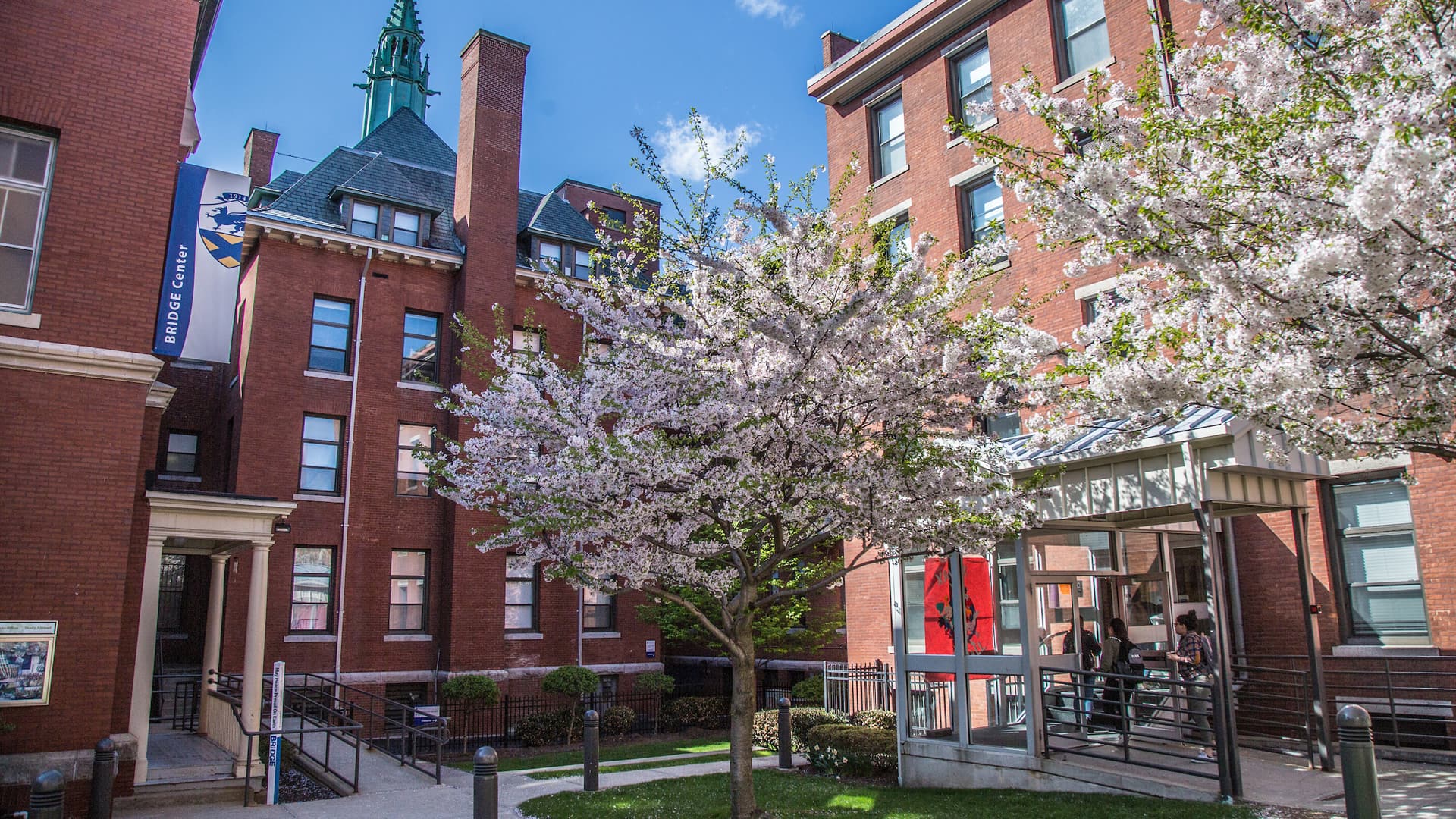
To find us, walk into the Xavier courtyard (via Claverick Street or through the Xavier Academic Complex). The Bridge entrance is directly across from Xavier Residence Hall. Our space is wheelchair accessible; a JWU ID is required to open the door.
Images below are FPO only:


